Rural urban migration
Thursday, August 19, 2010
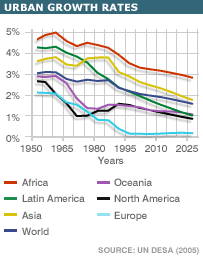
The world is fast approaching the point where the majority of the human population will be found in urban areas.
Somewhere, sometime in 2007, someone migrating from their rural home to begin a new life in a town or city will tip the global rural/urban balance, the UN estimates.
Throughout history, the world has experienced urbanisation but the huge rise in the number of people making their homes in towns and cities is a recent phenomenon.
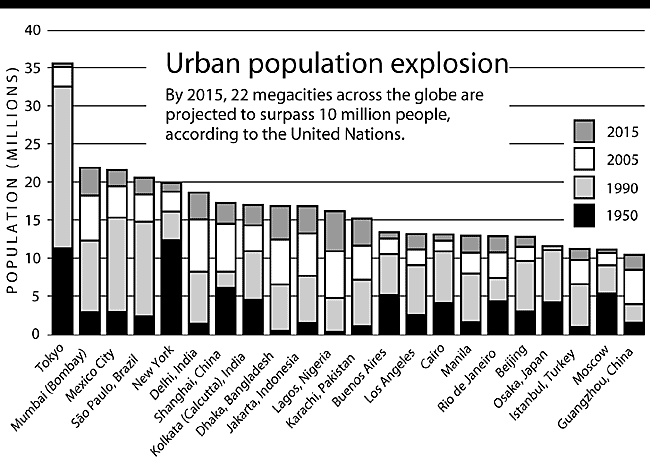
In 1950, less than one-in-three people lived in urban areas. The world had just two so-called "megacities" with populations in excess of 10 million: New York and Tokyo. Today, there are at least 20.
Greater Tokyo, the world's biggest city, has expanded from 13 million residents in 1950, to today's figure of 35 million.
The United Nations estimates that about 180,000 people are being added to the urban population every day. This means the world's urban infrastructure has to absorb the equivalent of the population of two Toykos each year.
North America and Europe's urban areas already account for about 70-80% of the regions' populations, and these are expected to stabilise at these levels.
Developing nations are shouldering the vast majority of this burden, leaving them struggling to cope with the huge influx of people into urban areas. Some cities' populations are 40 times larger than what they were in 1950.
In the traditional model of urbanisation, which North America and Europe experienced during the Victorian era, people were pushed away from the countryside by the mechanisation of agriculture, and pulled towards urban areas by the offer of jobs and wages.
'Premature urbanisation'
Sub-Saharan Africa, which has the world's highest rate of urban migration, is not following this pattern.
The size of its cities bears no resemblance to their economic wealth and are experiencing what the UN's human settlements agency, UN-Habitat, calls "premature urbanisation".
The agricultural sector is not flourishing and urban areas are not generating economic growth but failing crops, natural disasters and conflicts are forcing people to flood into towns and cities.
Currently, about 36% of Africa's population lives in urban areas but the continent is experiencing urbanisation rates twice as high as those seen during the West's industrial revolution. It is predicted that Africa will be an urban continent by 2030.
Because the urban areas are economically stagnant or in recession, local authorities do not have the money or expertise to provide services such as access to water, housing, education and healthcare.
As a result, 70% of Africa's urban population find themselves living in slums.
Africa is not alone. An estimated one billion people in Latin America, Asia, as well as Africa, live in slums or informal settlements that are not legally recognized.
Without any intervention, this number could double by 2020.
In Asia, China's urbanisation has followed the traditional drivers experienced by the West. Its industrial revolution is the most rapid the world has seen, and the Chinese government says it has helped lift more than 200 million people out of poverty.
Millions of people migrated from rural to urban areas to fill the jobs generated by the economic explosion.
Not everyone sees it that way. Anti-poverty campaigners say many workers receive low wages and live in poor conditions. An estimated 200,000 people each year move to slums on the southern outskirts of the capital, Beijing.
Seeking solutions
Although China's large-scale poverty reduction strategy could act as a framework for others to adopt, not all regions have the export markets and trade links that South East Asia enjoys.
UN-Habitat says the "urbanisation of poverty" has been overlooked. Traditionally, Western aid agencies have focused their efforts on the impact of floods, droughts and conflicts affecting rural dwellers.
In an effort to focus attention on the problem, the UN Millennium Declaration set the target of significantly improving the quality of life for 100 million slum dwellers by 2020.
The UK government's Commission for Africa said that the international community had to work together to tackle the urban poverty gripping the continent.
The commission's concluding report warned: "These slums are filled with an increasingly youthful population, unemployed and disaffected. Africa's cities are becoming a powder keg of potential instability and discontent."
More than 10,000 delegates are expected to attend the third World Urban Forum, being held later this month in Vancouver, Canada.
The two-yearly meeting, organised by UN-Habitat, is viewed as a chance to share experiences and knowledge, and aims to forge partnerships that will help deliver the goal of balancing urbanisation with a city's ability to absorb new inhabitants.
The delegates are aware of the growing sense of urgency of the challenge ahead because the next time they gather, they are likely to meet in an urban world.
Somewhere, sometime in 2007, someone migrating from their rural home to begin a new life in a town or city will tip the global rural/urban balance, the UN estimates.
Throughout history, the world has experienced urbanisation but the huge rise in the number of people making their homes in towns and cities is a recent phenomenon.
In 1950, less than one-in-three people lived in urban areas. The world had just two so-called "megacities" with populations in excess of 10 million: New York and Tokyo. Today, there are at least 20.
Greater Tokyo, the world's biggest city, has expanded from 13 million residents in 1950, to today's figure of 35 million.
The United Nations estimates that about 180,000 people are being added to the urban population every day. This means the world's urban infrastructure has to absorb the equivalent of the population of two Toykos each year.
North America and Europe's urban areas already account for about 70-80% of the regions' populations, and these are expected to stabilise at these levels.
Developing nations are shouldering the vast majority of this burden, leaving them struggling to cope with the huge influx of people into urban areas. Some cities' populations are 40 times larger than what they were in 1950.
In the traditional model of urbanisation, which North America and Europe experienced during the Victorian era, people were pushed away from the countryside by the mechanisation of agriculture, and pulled towards urban areas by the offer of jobs and wages.
'Premature urbanisation'
Sub-Saharan Africa, which has the world's highest rate of urban migration, is not following this pattern.
The size of its cities bears no resemblance to their economic wealth and are experiencing what the UN's human settlements agency, UN-Habitat, calls "premature urbanisation".
The agricultural sector is not flourishing and urban areas are not generating economic growth but failing crops, natural disasters and conflicts are forcing people to flood into towns and cities.
Currently, about 36% of Africa's population lives in urban areas but the continent is experiencing urbanisation rates twice as high as those seen during the West's industrial revolution. It is predicted that Africa will be an urban continent by 2030.
Because the urban areas are economically stagnant or in recession, local authorities do not have the money or expertise to provide services such as access to water, housing, education and healthcare.
As a result, 70% of Africa's urban population find themselves living in slums.
Africa is not alone. An estimated one billion people in Latin America, Asia, as well as Africa, live in slums or informal settlements that are not legally recognized.
Without any intervention, this number could double by 2020.
In Asia, China's urbanisation has followed the traditional drivers experienced by the West. Its industrial revolution is the most rapid the world has seen, and the Chinese government says it has helped lift more than 200 million people out of poverty.
Millions of people migrated from rural to urban areas to fill the jobs generated by the economic explosion.
Not everyone sees it that way. Anti-poverty campaigners say many workers receive low wages and live in poor conditions. An estimated 200,000 people each year move to slums on the southern outskirts of the capital, Beijing.
Seeking solutions
Although China's large-scale poverty reduction strategy could act as a framework for others to adopt, not all regions have the export markets and trade links that South East Asia enjoys.
UN-Habitat says the "urbanisation of poverty" has been overlooked. Traditionally, Western aid agencies have focused their efforts on the impact of floods, droughts and conflicts affecting rural dwellers.
In an effort to focus attention on the problem, the UN Millennium Declaration set the target of significantly improving the quality of life for 100 million slum dwellers by 2020.
The UK government's Commission for Africa said that the international community had to work together to tackle the urban poverty gripping the continent.
The commission's concluding report warned: "These slums are filled with an increasingly youthful population, unemployed and disaffected. Africa's cities are becoming a powder keg of potential instability and discontent."
More than 10,000 delegates are expected to attend the third World Urban Forum, being held later this month in Vancouver, Canada.
The two-yearly meeting, organised by UN-Habitat, is viewed as a chance to share experiences and knowledge, and aims to forge partnerships that will help deliver the goal of balancing urbanisation with a city's ability to absorb new inhabitants.
The delegates are aware of the growing sense of urgency of the challenge ahead because the next time they gather, they are likely to meet in an urban world.
[Via BBC]
Related: PERSPECTIVE OF URBANISATION IN PAKISTAN by by Shujaat H. Zaidi - Sociologist, Free Lance Consultant for Population, Family Planning, Women-in-Development and Honorary General Secretary of MSJ Research Institute.
Tags: Urbanization, Future
Labels: Urbanization
posted by S A J Shirazi @ 8:22 PM,
,


Urbanization - Rural to Urban Migration Trends
Wednesday, August 4, 2010
Tags: Urbanization, Migration Trends
For the first time in human history, the world's population is about to become mostly urban. Citing population growth rates and migration patterns, United Nations researchers and other experts predict that some time in 2008 more people will live in cities than in rural areas.
This demographic shift is mostly taking place in Africa and Asia, largely in low-income settlements in developing countries - much of it in the 22 "megacities" whose populations will exceed 10 million and in some cases grow to more than 20 million by 2015.
The environmental, economic, and social ramifications of such trends are enormous, according to the Worldwatch Institute's annual "State of the World" report released Tuesday. Among the major challenges are the mundane features of daily living: clean water and air, sanitary waste facilities, the cost of food, and the availability of shelter and transportation.
Unplanned and chaotic urbanization is taking a huge toll on human health and the quality of the environment, contributing to social, ecological, and economic instability in many countries," warns the report, which is written by demographers, international program officials, and other experts from the United States and other countries.
But the news is not all bad. Researchers find examples of cities from Karachi, Pakistan to Freetown, Sierra Leone to Bogotá, Colombia with projects aimed at improving the lives of urban dwellers while reducing the environmental impact of concentrated populations. These include urban farming plots, solar water heaters, economic cooperatives, improved sewer facilities, and upgraded transportation systems.
"The task of saving the world's modern cities might seem hopeless - except that it is already happening," says Worldwatch president Christopher Flavin. "Necessities from food to energy are increasingly being produced by urban pioneers inside city limits."
Still, the challenges and the probable costs of addressing them remain daunting. Eight of the 10 most populous cities are on or near earthquake faults. Some two-thirds of the cities projected to exceed 8 million residents by 2015 are in coastal areas where sea levels may rise as a result of climate change.
But the human need is more immediate. Of the 3 billion people who live in cities today, about 1 billion are in slums without clean water, adequate toilet facilities, or durable housing. Some 1.6 million urban dwellers - many if not most of them children - die each year due to causes associated with the lack of clean water and sanitation.
"For a child living in a slum, disease and violence are daily threats, while education and healthcare are often a distant hope," says Molly O'Meara Sheehan, project director of Worldwatch's 2007 report, a collection of articles and graphics produced annually since 1984.
This argues for a reassessment of global development priorities, advocates say, particularly the allocation of national and international aid. According to the Commission for Africa, launched by British Prime Minister Tony Blair in 2004, problems associated with urbanization are second only to HIV/AIDS on the world's most rapidly urbanizing continent.
Yet from 1970 to 2000, aid designated for cities in developing areas was just 4 percent of total development assistance worldwide. This was the period when many countries in Africa were transitioning politically and economically from European colonialism to independence.
"Too many of us were ill prepared for our urban future," notes Anna Tibaijuka, executive director of UN-HABITAT, the United Nations agency that promotes socially and environmentally sustainable towns and cities with the goal of providing universal adequate shelter.
"The promise of independence has given way to the harsh realities of urban living," writes Dr. Tibaijuka, an agricultural economist and native of Tanzania, in the report's foreword.
By 2015, there are likely to be 59 African cities with populations between 1 million and 5 million, 65 such cities in Latin America and the Caribbean, and 253 in Asia.
"Urban centers are hubs simultaneously of breathtaking artistic innovation and some of the world's most abject and disgraceful poverty," writes Mr. Flavin. "They are the dynamos of the world economy but also the breeding grounds for alienation, religious extremism, and other sources of local and global insecurity."
Cities also exemplify the challenges and promises of sustainability. China, for example, has 16 of the world's most polluted cities. But on an island in the Yangtze River near Shanghai, China this year plans to break ground on the Dongtan ecocity project designed to be nearly self-sufficient in food, water, energy, and waste disposal for its projected 500,000 residents
Labels: Urbanization
posted by S A J Shirazi @ 1:22 PM,
,


