Visit to Professional College, Depalpur
Tuesday, October 20, 2015

Labels: Amjad Ali, Appropriate Technology, Prof Dr Norbert Pintsch, Rural Culture, SES, Thatta Kedona, TTTC, VoG
posted by S A J Shirazi @ 8:00 AM,
,


Celebrating the Rich Culture
Saturday, December 7, 2013
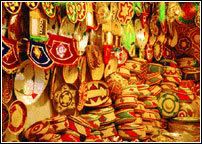 Organised annually, at the start of the winter season in the federal capital by the Ministry of Culture and Lok Virsa, the Lok Virsa Festival provides an opportunity to local and foreign visitors to savour the cultural diversity of Pakistan in all its colourful splendour.
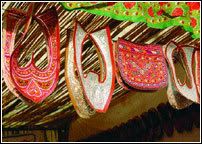 The event is also an endeavour for creating in Pakistanis an understanding and appreciation for cultures and communities that exist in other regions of the country. In this way, this cultural gala also plays a role in forging and fostering national harmony and integration.
Marked by verve and zest, with folk artists and artisans dressed in gay, multi-hued attires, dancers swaying to traditional tunes, musicians singing traditional songs, craftsmen creating and displaying their traditional arts and crafts, one experiences a highly palpable excitement upon visiting the festival. And then there is the rural cuisine which is also a part of this colourful fair.
In addition to providing the general public with entertainment and also the rare opportunity of seeing and enjoying the diverse cultures that dot the landscape of Pakistan, all in one place, this two-week long festival also exposes the artists and artisans to trade and economic transaction as local and foreign businessmen also visit the festival with the view of finding arts, crafts and goods that might be attractive business propositions for them. Thus the festival also has a positive economic purpose.
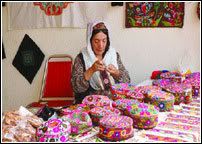 The holding of this event in Islamabad has a symbolic value since being the capital of Pakistan, it represents the federation and the unity of the federating units. However, it would be a welcome idea if such festivals were also organised in all the four provincial capitals, allowing a greater number of Pakistanis to experience and enjoy the vast cultural vista of Pakistan. {Via Dawn}
Labels: Rural Culture
posted by S A J Shirazi @ 8:30 AM,
,
Village Life
Tuesday, October 29, 2013

Labels: NGOs, Rural Culture, TGD
posted by S A J Shirazi @ 9:50 AM,
,
Rural Culture
Tuesday, April 16, 2013
The culture, the traditional rural culture and the industrial city culture, the contents, the characteristics, changes are more or less the topics of discussion in various considerations on the subject. It may not be clear to many where the problem really is, or why the restlessness, why the discussion?

The term Culture is gladly used in these times. To be lacking in culture or be devoid of culture, no please! It does not surprise when one talks of eating, sleeping and drinking cultures. Educated people have the reading culture. Many are members of special cultures like leisure activities. One is sure to maintain high standard in body culture, which is by the way synonymous with the intensive use of perfumes. It underlines the positive image towards outside.
Labels: Dr. Norbert Pintsch, Rural Culture
posted by S A J Shirazi @ 8:00 AM,
,
Urbanization
Saturday, December 8, 2012
Human beings like other organisms, have always polluted their environment with the byproducts of their action. As an organism man creates waste. As a social creature, he removes things from his environment and adds residue to it. So long as population density has been low on the planet, the environment was able to accommodate these alterations. Now with the world population about 8.5 billion people and increasing by 220,000 each day, the concentration of population in cities and resulting deterioration of environment is sounding alarms. The situation is urban Pakistan is worst.
The process of economic development over last 58 years has brought number of changes. One of the most critical dimensions of the process is urbanization of rural society. As the development has taken place primarily from agricultural to industrial economy, large scale rural to urban migration has taken place, changing the face of our cities as well as villages. The concentration of more and more people into urban areas is regarded as one of the major environmental threat today. The process is expected to escalate in Pakistan though many of our cities have already reached the point where further population concentration (by natural birth or migration) may jeopardize the delivery of basic civic services to all.
Labels: Rural Culture, Urbanisation
posted by S A J Shirazi @ 10:40 AM,
,
Rural Lifestyle
Thursday, September 27, 2012

Best mud hut in Thatta Ghulamka Dgeroka

Best exterior

Best brick house

Thatta Kedona stall

Growing with Thatta Kedona

Meeting

Volunteers at work

Some of those who work togather to make all that happen
More images in daily zeitgeist down the sidebar.
Labels: Homes and Houses, Rural Culture, Rural Development
posted by S A J Shirazi @ 9:23 AM,
,
TGD Life
Wednesday, July 4, 2012

Labels: Rural Culture
posted by S A J Shirazi @ 8:00 AM,
,
Charkha
Wednesday, March 14, 2012

Labels: Artifacts, Rural Culture
posted by S A J Shirazi @ 9:07 AM,
,
How People Marry in Rural Pakistan
Saturday, May 21, 2011
 Rural areas of Pakistan still remain a largely conservative society, where many young people shy away when it comes to marriages. Exceptions apart, arranged marriages are a cornerstone of rural society. It remains the responsibility of parents and marriages are mostly among people within the same tribe, caste, community, family or locality.
This is what happens in rural areas with some minor changes from place to place: After initial understanding and covert messages between families of prospective spouses, the boy's relatives visit the girl's family and offer the proposal, on formal acceptance the "mangni" (engagement) takes place, marriage date is fixed, groom, with friends and relatives goes to the house of the bride in the form of barat (marriage procession) where the nikah (social contact) is performed. The consent of the bride and the groom to the marriage (ijab and qabool) in the presence of at least two witnesses is obtained to solemnize the contract as per the commandment of divine Islam. Guests are served with sumptuous food (notwithstanding what the law of the land says about the feast). Groom brings home his the bride. This is followed by Walima. Life goes on . . .
Moreover, on the arrival of barat, the dowry is displayed for every one to see and at the same place groom's female relatives show what they have gifted (jewellery and clothing) to the bride. Both sides glorify the gifts. Paradoxically, in Punjab, a night earlier than the marriage date, groom visits homes of his friends and relatives where he is offered money. Other gifts mostly in the form of money (salami) or garlands made of currency notes are presented when groom gets ready for going to bride's home. Customarily, groom dresses up in attire presented to him by one of his sisters and in return, he gives to his sister(s) what she demands. There are no marriage halls and the congregations take place in homes and or community centres (called Daras). There are no caterers. Local tradesmen prepare food and serve.
As per the available statistics, divorce rate in the rustic areas is comparatively lower. The core join family system is still in tact and that is one of the reasons for low divorce rate. At the other hand, marriages at very young age, consanguineous marriages, marriages without consent of the partners and cross marriages are common.
There is not much of a variation in the core marriage ceremonies in urban areas, only the way they are performed differ. In the cities, the assertive sons and daughters of an educated middle-class are finding new ways of meeting their match. Although many still have arranged marriages, it is no longer unheard of for couples to marry after having fallen in love or meting over the Internet or in a TV show. Court marriages are also not very uncommon.
Difference in thinking between modern urban elites and traditional rural families is reflected in marriages in many ways. Norms in the urban society have changed over the years and they are on the constant move. Vulnerable to satellite TV, Internet, higher education and affluence, urban population is open and highly receptive to the waves of modernity. Unlike in the past, the selection of marriage partners now is done from the groups that are similar in social characteristics. In present times, urbanites are now most likely to marry individuals who are in similar social group, educational attainment and social class.
Another interesting pattern that is now visible is the strong influence of the western society, which has now trickled down its norms to our youth who have proudly inculcated them into being 'ours'. People in urban areas are slowly but surely moving towards the conjugal family system from our traditional and inherited consanguine system. Twenty years ago the scenario in Pakistani cities was quite the contrary.
Families in urban areas are strongly influenced by the environment and by technology in particular. To take a historic overview, as Pakistani society industrialised some 25 years ago, families lost their old patterns and received changed values. This resulted among other things, in smaller families in urban areas of Pakistan. In addition many of the functions, once attributed to the families became the responsibilities of other institutions and individuals. It was because of the shift to a more formal societal structure that romantic love is replaced by economic and social reasons as a factor influencing the choice of a marriage partner. The role of women has also changed as the family is losing control over the destinies of its female members.
Matchmaking by the third party is a preferred way now. This has given rise to match making business. Interested people are asked to provide details of eligible sons and daughters, as well as their requirements from a spouse and matchmakers do rest of he job. Marriages take place at marriage halls and hotels instead of homes. Dowry, usually, is sent to the bride's home before the marriage.
The affluence and wealth makes a large difference in weeding ceremonies, in rural as well as urban areas. The more people have, the more elaborate are the rituals. But spirit everywhere remains the same.
Labels: Rural Culture
posted by S A J Shirazi @ 10:52 AM,
,
Rajasthan Art
Tuesday, February 1, 2011
"Handicraft is one of the most important aspects of Rajasthan’s life. People have been involved in hand-made crafts for ages which are now being modified by the new generation with the help of contemporary designs to make the products competitive in the market,” said Amita Gupta, founder member of Routes 2 Roots, an NGO which organised a festival in Karachi, in collaboration with the Indian Council of Cultural Relations (ICCR) as part of the initiatives to bring together people, cultures and values across Saarc countries, reports F.I.
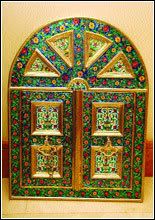
Popularly known as the ‘treasure trove of Indian handicrafts’ and ‘shoppers paradise’, Rajasthan, one of the most fascinating lands of India, has been able to preserve its craft over the centuries. In fact, unique in colour and workmanship, Rajasthani art is an institution in its own right.
Recently, Karachiites were given an opportunity to enjoy the culture and cuisine of Rajasthan. A five-day-long festival, which was organised at a local hotel, was the first of its kind in the country. A team of 22 people, including musicians, chefs and artisans from India, participated in the event which also showcased performances by traditional Kalbelia dancers.
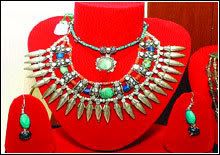
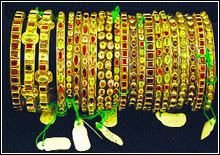
A part of this festival was a handicraft exhibition. The items on display included enameled jewellery and jewellery boxes embellished with semi-precious stones, glass bangles, embroidered dresses, saris, quilts, purses, handbags, bedsheets, decoration pieces and handloom fabric called kota doria.
“Handicraft is one of the most important aspects of Rajasthan’s life. People have been involved in hand-made crafts for ages which are now being modified by the new generation with the help of contemporary designs to make the products competitive in the market,” said Amita Gupta, founder member of Routes 2 Roots, an NGO which organised the festival in collaboration with the Indian Council of Cultural Relations (ICCR) as part of the initiatives to bring together people, cultures and values across Saarc countries.
Though on a steep side, the handicraft with intricate designs intrigued many who took time to inquire about the techniques used in making the striking jewellery and kota doria fabric, two popular features of the handicrafts from Rajasthan.
“The enamellers of Jaipur design the best pendants, necklaces, anklets, naths and even spoons, knives, key chains and cufflinks. One of the best known Jaipur enamellers was my father who made a small elephant of gold which was exhibited at many art exhibitions in various parts of the country,’ said Deepak Sankit, who won the National Merit Award for Enamelled Gold Jewellery in India.
About the process of enameling a product, the visitors were told that once gold is given the required shape, it is covered with a sealing wax. The ornament is then scratched on with a pointed instrument and the required designs are carved on it. The designs are usually images of birds, flowers and even landscapes. After the designs are made, the enamel dust or powder of different coloured glasses is put into the cavities. The ornament is placed in a hot furnace; the enamel melts and diffuses proportionately into the cavities. It is then taken out and burnished with a wet stone. The process is repeated until the required polish is attained. Sometimes it takes months to finish one piece of jewellery.
Women took special interest in kota doria. Skillfully made of cotton and silk yarn in different combinations, kota doria is transparent and its beauty is further enhanced by batik and block printing, embroidery, cutwork and tie and dye techniques. Among the decorative items, metal carved doors, a pair of silver hookah, wooden chairs and paintings on handcrafted pieces of marble with old polish and modern day colours were marvellous.
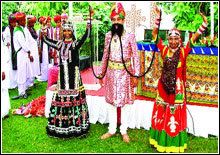
“This was an overwhelming experience. We are extremely impressed by the hospitality of the Pakistanis. Yesterday, I received a call from Hyderabad and was requested to hold a similar festival there. We are looking forward to organising more such programmes that can bring people of the two countries together,” said Tina Vachani, one of the organisers.
Labels: Rural Culture
posted by S A J Shirazi @ 1:22 PM,
,
Rural Urban Migration
Thursday, January 27, 2011

Labels: Rural Culture, Rural Development
posted by S A J Shirazi @ 8:57 AM,
,
Rural Culture
Sunday, January 23, 2011
Labels: Rural Culture
posted by S A J Shirazi @ 2:00 PM,
,
Traditional Culture
Saturday, January 1, 2011
The most important factors for the current development were laid in the 19th century. The rejection of thinking and acting as a community meant for the technology an enormous increase in the industrial production because the division of work led to higher productivity and new professions and it appeared on the face of it to increase the standard of living in western cultures (for example the Taylorism as introduced in Ford automobile factories etc.)
Analysis of the society by political and economic thinkers led to development theories, which could not foresee the effects of these policies as evidenced today. The cardinal error by these theorists was the euro-centristic model, i.e. nobody took the happenings in other cultures into consideration.
In Smith's economic system, the free market functioned globally, as long as global meant regionally and maximum on a national level.
In Marx's political system the democracy functions internationally, as long as the power base is centrally located. This concept is also found in antique Greek city-state models on a local basis.
In both cases, there appears to be consensus on one point, i.e. that "multiple behavioral models (Artenvielfalt)" are not acceptable in these theories. But this is probably precisely the decisive error.
With this sketch, we would now like to analyze the present situation.
Present situation
It is the market factors in a democratically functioning society, which determines the general welfare of the people.
Since the market -in the traditional sense- neither takes into consideration the environment nor the traditional cultures, which are present in rural areas and production of goods leads to certain uniformity because of cost-reduction methods. Every effort must be undertaken, so that the (B.E.P.) does not fall short of targets under any circumstances. The multi-national concerns attempt by adding more products to their production programs to offer a variety of models: since all parties participating in the market work in similar way, but the demand in the market is relatively fixed and not able to be increased arbitrarily, it is clear where the wastage of resources is taking place.
The winner is the one, who has the largest potential of human resources as long as these can be controlled politically.
The intentions and the wishes of so-called democratic countries are understandable, if they exert all possible pressure on others to accept their form of governance.
If this effort does not succeed, their system -let us call it "western system"- would collapse together with all parties involved in it.
There are incredible factors, which remain unconsidered by the members of the City-Culture, they being the innovators and carriers of the enormous misunderstandings and the cardinal errors:
a) There are very different cultures
b) These cultures have developed over a long period of time in inter-action with the climate and the environment.
c) Each culture has its own set of rights and should be the subject of research to shed light on this enormous richness.
Of course much of the matter has been lost due to the way of thinking and the actions undertaken up till now, but exactly this is the task before us; to track down these materials.
Misuse of environment and resources are hardly a subject of discussion in economic appraisals. Similarly, the richness of traditional cultures, which still exist at least in part in the rural areas, which are typically described as "under-developed" is not mentioned in these appraisals. There is no code or value allocated to them. Only when the value has been destroyed, the damage becomes visible. The extent of destroyed traditional cultures is quite evident in the number of museums, i.e. as soon as the traditional cultures began to be considered as money making measures for the institutions, they received recognition as a valid market factor, but in effect became still more unstable.
As the international flow of money is not directed towards local industry and national states, there is a trend towards uniformity through optimization and standardization. This uniformity can be concealed through various designs and requires increased consumption of goods. In order to increase the consumption, the consumers (all consumers of the world unite!!) require financial means, which are actually not available to the majority of population.
Outlook
A special sort of market is created at the place where traditional cultures are promoted. Members of the community have a chance to participate, if they consider it a possibility to maintain their basic requirements, i.e. a form of satisfaction of most basic material needs must remain intact.
Prof Dr Norbert Pintsch, Voluntary Director, TTTC TGD
Labels: Prof. Dr. Norbert Pintsch, Rural Culture
posted by S A J Shirazi @ 8:03 AM,
,
Punjab culture
Saturday, December 18, 2010

Labels: Rural Culture
posted by S A J Shirazi @ 10:00 AM,
,
In the village
Wednesday, July 21, 2010
Labels: Rural Areas, Rural Culture
posted by S A J Shirazi @ 3:41 PM,
,


